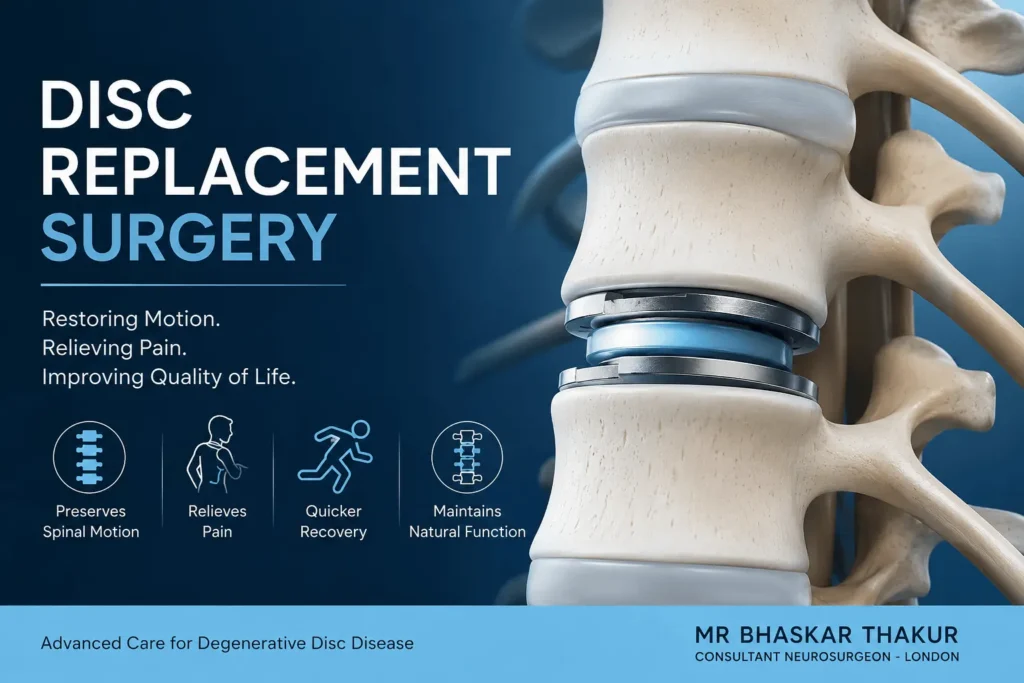
Disc replacement surgery, also known as artificial disc implantation or motion-preserving spinal surgery, is an advanced procedure used to treat painful degenerative changes affecting the cervical or lumbar spine. The operation involves removing a damaged intervertebral structure and replacing it with an artificial implant designed to preserve movement, maintain vertebral spacing, and support long-term spinal function.
Mr Bhaskar Thakur is a consultant neurosurgeon in London with expertise in minimally invasive spinal surgery, nerve compression disorders, cervical radiculopathy, lumbar degeneration, and complex conditions affecting the neck and lower back.
Artificial implantation procedures may be considered in carefully selected patients experiencing persistent neck pain, lower back pain, arm pain, leg pain, or neurological symptoms caused by degeneration, foraminal narrowing, or mechanical instability that has not improved with physiotherapy, rehabilitation, medication, or injection therapy.
Unlike fusion procedures, motion-preserving surgery aims to maintain flexibility and controlled movement at the treated vertebral level while relieving pain and improving functional mobility.
Understanding Degenerative Changes Within the Spine
The vertebral column is made up of bones, joints, ligaments, nerves, muscles, and intervertebral cushioning structures that help absorb mechanical stress during movement.
Over time, these structures may undergo degenerative changes associated with ageing, repetitive strain, reduced hydration, previous injury, occupational stress, or altered spinal biomechanics.
As degeneration progresses, patients may develop inflammation, reduced flexibility, nerve irritation, spinal stiffness, or instability affecting mobility and quality of life.
In some individuals, deterioration affecting the cervical or lumbar region may contribute to neural compression, cervical radiculopathy, sciatica, arm pain, leg pain, numbness, tingling, or muscular weakness.
What Is Artificial Disc Replacement?
Intervertebral cushioning structures act as shock absorbers between the vertebrae and help support movement throughout the spine. Degeneration or injury affecting these structures may lead to persistent pain, inflammation, instability, and nerve-related symptoms.
The procedure involves removing the affected intervertebral structure and inserting an artificial implant designed to preserve vertebral spacing, flexibility, alignment, and controlled movement.
Motion-preserving surgery may be performed in different regions of the spine, including:
- Cervical arthroplasty (neck)
- Lumbar arthroplasty (lower back)
The most appropriate treatment approach depends on neurological findings, spinal alignment, structural stability, imaging results, and the number of vertebral levels involved.
Conditions That May Be Treated With Motion-Preserving Surgery
Artificial implantation procedures may be considered for several conditions affecting the cervical or lumbar region.
- Degenerative disc disease
- Slipped disc (disc prolapse)
- Chronic lower back pain
- Mechanical neck pain
- Nerve root compression
- Cervical radiculopathy
- Lumbar nerve irritation
- Foraminal stenosis
- Loss of vertebral height
- Single-level degeneration in selected patients
Patients experiencing persistent neurological symptoms despite conservative treatment may benefit from specialist spinal assessment to determine whether artificial implantation or alternative treatment options are appropriate.
Surgical Technique and Motion Preservation
During surgery, the degenerated vertebral segment is carefully accessed using specialised microsurgical techniques designed to minimise disruption to surrounding tissues.
The affected cushioning structure is removed to relieve pressure on nearby nerves or neural structures while restoring spacing between the vertebrae.
An artificial implant is then positioned between the vertebral bodies to maintain movement and preserve spinal biomechanics.
The procedure aims to:
- Relieve mechanical pain
- Reduce neural compression
- Restore vertebral height
- Preserve mobility and flexibility
- Improve posture and alignment
- Reduce nerve-related symptoms affecting the arms or legs
Advanced imaging, intraoperative navigation, and surgical planning techniques may assist with implant positioning and alignment during the procedure.
Preserving Movement and Biomechanical Function
One of the major advantages of motion-preserving procedures is the ability to maintain movement at the treated vertebral level while relieving pressure on surrounding neural structures.
Maintaining movement may help reduce abnormal mechanical stress affecting neighbouring vertebral segments and support more natural spinal biomechanics during daily activities.
This approach may be particularly beneficial in selected patients with isolated degeneration affecting a single cervical or lumbar level.
Compared with fusion procedures, preserving movement may reduce stiffness and maintain flexibility in certain patients following surgery.
Artificial Disc Replacement vs Fusion Surgery
Both artificial implantation and fusion surgery are used to treat painful degenerative conditions affecting the spine, but the procedures work differently.
Fusion surgery permanently joins vertebrae together to improve stability, whereas motion-preserving surgery is designed to maintain flexibility at the treated level.
Potential advantages of motion-preserving techniques may include:
- Maintenance of natural movement
- Reduced stiffness
- Preservation of flexibility
- Lower stress on adjacent vertebral levels in selected patients
- Earlier return to mobility in some cases
However, not every patient is suitable for artificial implantation, and careful neurological and radiological assessment is important when determining the most appropriate treatment strategy.
Minimally Invasive Surgical Approaches
Modern arthroplasty procedures are often performed using minimally invasive techniques designed to reduce tissue disruption and support postoperative recovery.
Compared with traditional open surgery, these approaches may involve:
- Smaller incisions
- Reduced muscular disruption
- Lower blood loss
- Reduced postoperative discomfort
- Earlier mobilisation
- Shorter hospital stays in selected patients
Patients with back pain, neck pain, or sciatica caused by degeneration or neural compression may benefit from minimally invasive treatment strategies depending on the underlying diagnosis.
Who May Be Suitable for Surgery?
Artificial implantation procedures may be considered in patients who continue to experience symptoms despite physiotherapy, rehabilitation, pain management, and lifestyle modification.
Potential candidates may include patients with:
- Persistent neck or lower back pain
- Cervical radiculopathy
- Lumbar nerve compression
- Mechanical pain affecting movement
- Single-level degeneration
- Nerve-related arm or leg symptoms
- Reduced flexibility and mobility
Every patient undergoes detailed clinical assessment, neurological examination, and MRI imaging before surgery is recommended.
Factors such as osteoporosis, spinal instability, arthritic joint disease, deformity, or multilevel degeneration may influence suitability for motion-preserving procedures.
Recovery After Surgery
Recovery timelines vary depending on the complexity of the condition, the vertebral level treated, and the patient’s overall health.
Many patients begin mobilisation shortly after surgery and return home within a relatively short hospital stay.
Postoperative rehabilitation commonly involves:
- Physiotherapy and mobility training
- Walking programmes
- Strengthening exercises
- Posture and ergonomic guidance
- Follow-up imaging and neurological assessment
Patients recovering from surgery for neural compression or degenerative disease may gradually notice improvement in mobility, flexibility, posture, and nerve-related symptoms during rehabilitation.
Potential Risks and Considerations
As with all major procedures, artificial implantation carries potential risks and limitations.
Possible risks may include:
- Infection
- Bleeding
- Nerve irritation or neurological injury
- Implant-related complications
- Persistent pain
- Reduced movement
- Anaesthetic risks
Not every patient with degenerative spinal disease is suitable for motion-preserving surgery. Treatment recommendations depend on imaging findings, neurological symptoms, structural stability, spinal alignment, and overall musculoskeletal health.
Living With Degenerative Spinal Disease
Degenerative conditions affecting the neck and lower back may significantly interfere with mobility, work, sleep, exercise tolerance, and overall quality of life.
Some patients experience persistent pain and neurological symptoms that interfere with normal daily activities despite physiotherapy, medication, rehabilitation, and ergonomic adjustments.
Early specialist assessment may help identify whether symptoms are related to degeneration, neural compression, or biomechanical instability and whether surgical treatment may be appropriate.
With appropriate treatment and rehabilitation, many patients achieve improved mobility, reduced pain, and long-term functional improvement.
Specialist Disc Replacement Surgery in London
Mr Bhaskar Thakur is a consultant neurosurgeon in London with expertise in artificial disc replacement, cervical arthroplasty, minimally invasive spinal surgery, and advanced treatment for degenerative conditions affecting the neck and lower back.
Patients across Harley Street, Central London, Essex, and surrounding areas may seek specialist assessment for chronic neck pain, lower back pain, slipped disc disease, cervical radiculopathy, lumbar nerve compression, and persistent mobility problems affecting daily activities.
Early specialist assessment may help determine whether artificial implantation, fusion procedures, rehabilitation, or non-surgical treatment options are most appropriate based on imaging findings and neurological symptoms.
Book a Consultation
If you are experiencing persistent neck pain, lower back pain, arm symptoms, leg pain, or nerve-related mobility difficulties, specialist assessment may help identify appropriate treatment options.
Reviewed by Mr Bhaskar Thakur
Mr Bhaskar Thakur is a consultant neurosurgeon specialising in minimally invasive spinal surgery, cervical arthroplasty, degenerative spinal disease, nerve compression disorders, and advanced neurosurgical care in London and Essex.
