 Mr Bhaskar Thakur

Numbness after spine surgery can be concerning, especially when back or leg pain has improved but part of the leg, foot, or toes still feels numb. In many cases, persistent numbness does not mean that the surgery has failed. A nerve that has been compressed or irritated before surgery may take considerably longer to recover than it takes for pain to settle.
How long numbness lasts varies from person to person. Recovery depends on factors such as the underlying spinal condition, how severely the nerve was affected, how long it was compressed, the type of surgery performed, and the condition of the nerve before treatment.
Table of Contents
Is Numbness After Spine Surgery Normal?
Some patients continue to experience numbness for a period after spine surgery, particularly when a spinal nerve was compressed or irritated before the operation.
The purpose of many spine procedures is to relieve pressure on an affected nerve. Treating the source of compression can reduce further irritation, but it does not necessarily restore normal nerve function immediately.
This means different symptoms can improve at different rates. Severe back or leg pain may settle relatively quickly, while numbness, tingling, or altered sensation can remain for considerably longer.
A gradual improvement in symptoms is generally more reassuring than symptoms that are progressively worsening. However, new or worsening neurological symptoms after surgery should be discussed with the treating medical team.
Why Does Numbness Remain After Spine Surgery?
There are several reasons why numbness can persist following spine surgery.
The Nerve May Have Been Compressed for a Long Time
A nerve that has been under pressure for an extended period may become irritated or damaged. Surgery can relieve the pressure, but the nerve may still need time to recover.
This is particularly relevant when numbness, weakness, or other nerve-related symptoms were present for a long time before surgery.
Nerves Recover Gradually
Nerve function does not necessarily return to normal immediately after decompression. Recovery can occur gradually, and sensory symptoms may take longer to settle than pain.
The fact that numbness remains after surgery therefore does not, by itself, indicate that the procedure has not worked.
There May Be Temporary Inflammation
Surgery causes a normal healing response in the tissues around the operated area. Temporary inflammation can contribute to altered sensations during the early postoperative period.
As healing progresses, these symptoms may change or gradually settle.
The Nerve May Have Been Significantly Affected Before Surgery
If a nerve was severely compressed before the operation, its function may take longer to recover.
In some cases, significant pre-operative nerve injury can result in lasting sensory changes even after the original source of compression has been treated.
What Does Numbness After Spine Surgery Actually Feel Like?
Numbness does not always mean that an area has completely lost sensation. Patients can experience changes in sensation in several different ways after spine surgery.
For example, you may notice that:
- The skin feels less sensitive than before surgery
- Your foot or leg feels as though it is “asleep”
- You have pins-and-needles sensations
- Part of the leg feels different when touched
- You notice burning or other unusual sensations
- The skin feels unusually sensitive in certain areas
- Your foot feels strange when it touches the ground while walking
These symptoms can occur when a nerve that was previously compressed or irritated is still recovering.
The character of the sensation can also change during recovery. An area that initially felt completely numb may later develop tingling or increased sensitivity before sensation becomes more normal.
However, changes in sensation should always be considered alongside other symptoms. New weakness, rapidly spreading numbness, or significant worsening should not simply be assumed to be part of normal recovery.
Why Does Pain Improve Before Numbness?
This is one of the most common concerns after spine surgery.
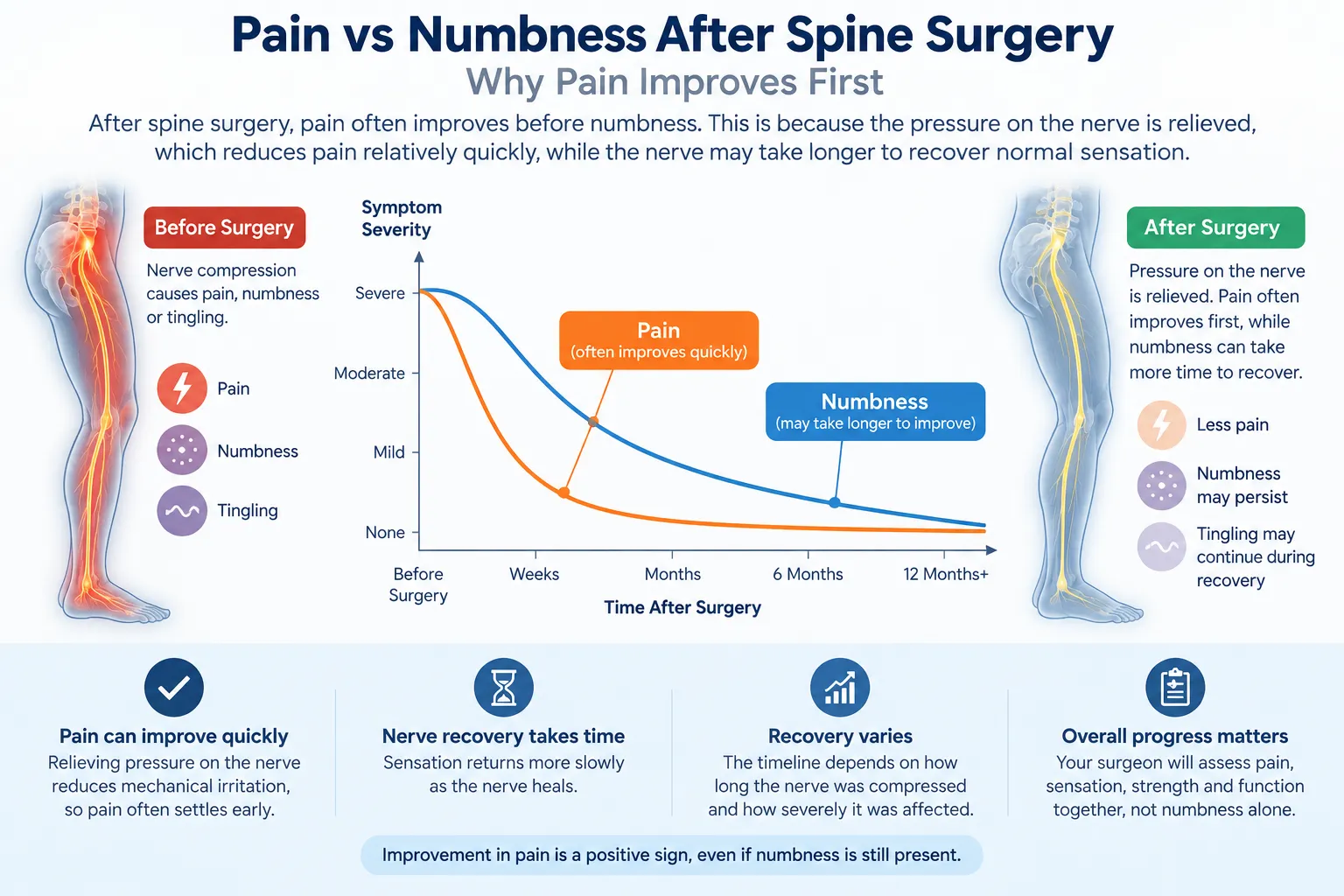
A patient may find that the shooting leg pain or sciatica has improved significantly, while part of the foot or leg remains numb.
This can happen because pain and sensation do not necessarily recover at the same rate.
When pressure on a spinal nerve is relieved, the source of mechanical irritation may be reduced relatively quickly. As a result, shooting or burning pain can improve before normal sensation returns.
Numbness, altered sensation, or tingling may persist while the affected nerve continues to recover.
Therefore, persistent numbness does not automatically mean that the operation has been unsuccessful.
Your surgeon will usually consider the overall pattern of recovery, including pain, strength, sensation, mobility, and other neurological symptoms.
How Long Does Numbness Last After Spine Surgery?
There is no single recovery time that applies to everyone.
Some patients notice changes in sensation within weeks, while others continue to experience numbness for several months or longer. When a nerve has been significantly or chronically compressed, sensory recovery may take considerably longer.
The important point is that recovery should not be judged solely by a fixed number of weeks.
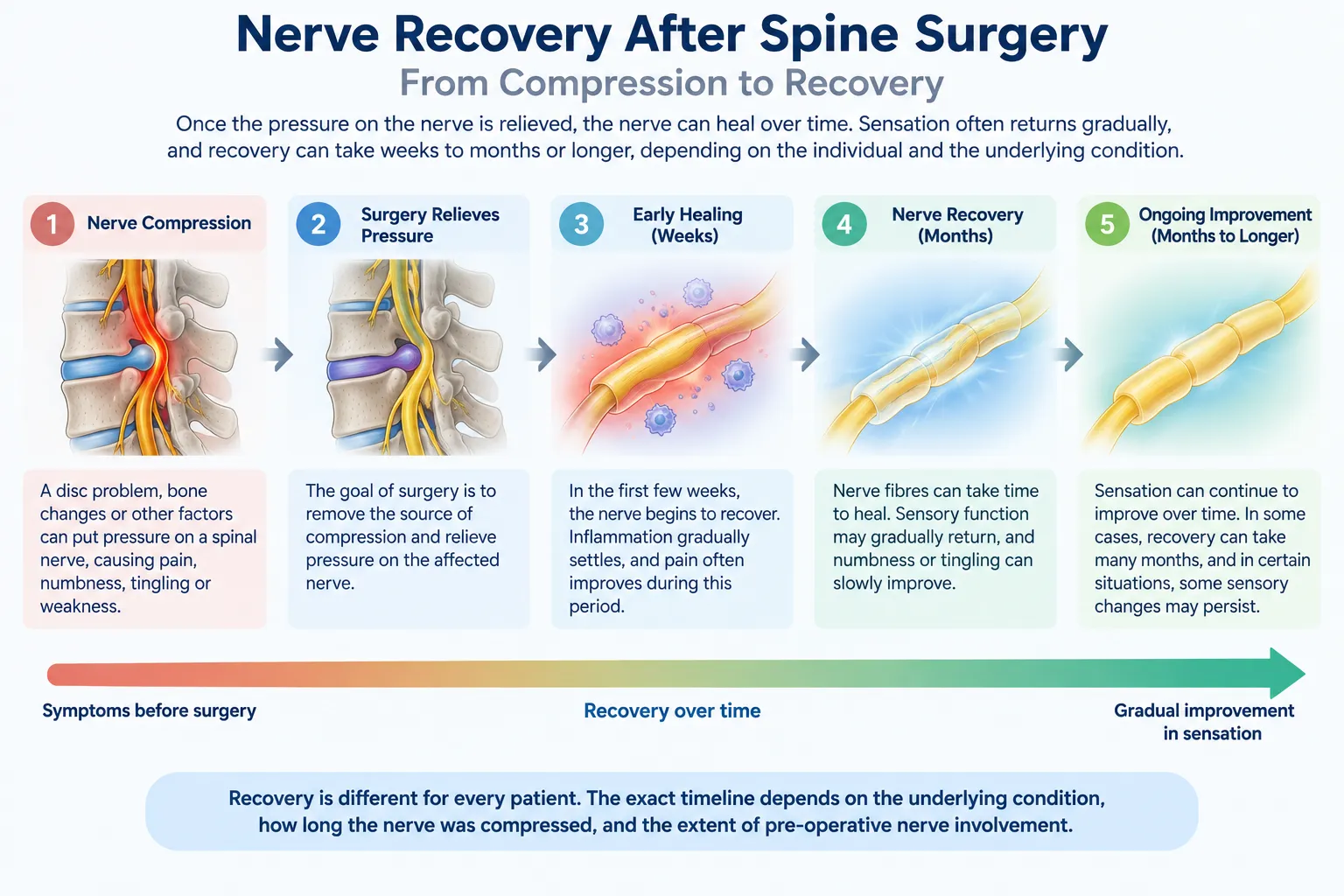
The original diagnosis, severity and duration of nerve compression, condition of the nerve before surgery, and type of operation can all influence recovery.
A useful way to understand the process is:
Pressure on the nerve is relieved → the nerve continues to recover → sensation may gradually improve.
Recovery is not necessarily linear. Some patients notice steady improvement, while others experience periods where symptoms change very little before becoming noticeably better.
If numbness is gradually improving, this can be reassuring. If it is becoming more extensive or is accompanied by new weakness or other neurological symptoms, medical assessment is important.
What Does Improving Numbness Look Like?
Nerve recovery does not always happen as a sudden change from “numb” to “normal.” Improvement may be gradual and can sometimes be difficult to notice from one day to the next.
Some signs that sensation may be changing include:
- The numb area becomes smaller
- You begin to notice touch in an area that previously felt completely numb
- The intensity of the numbness decreases
- Pins and needles replace an area of complete numbness
- Sensation becomes more consistent over time
- The affected foot or leg gradually feels more normal during everyday activities
Recovery is not necessarily linear. You may notice improvement for a period and then feel that your symptoms have changed very little for a while.
For this reason, it is usually more useful to consider the overall trend rather than judging recovery from a single day.
If sensation is gradually returning and there are no new neurological problems, this may be reassuring. If numbness is progressively worsening or accompanied by weakness, your surgeon should assess the change.
Does Persistent Numbness Mean the Nerve Is Still Compressed?
Not necessarily.
Persistent numbness after surgery does not automatically mean that the nerve remains compressed. A nerve can continue to have altered function even after the original source of pressure has been successfully treated.
This is one reason symptoms do not always disappear immediately after decompression surgery.
There is an important difference between persistent symptoms that are stable or gradually improving and symptoms that are new, worsening, or accompanied by neurological deterioration.
If numbness is stable or slowly improving, your surgeon may consider it part of the ongoing recovery process. On the other hand, increasing numbness, new weakness, worsening pain, or other neurological changes may require further assessment.
Your clinical examination and overall recovery are more informative than numbness alone. If your surgeon has concerns about persistent or changing symptoms, they can determine whether further investigation is necessary.
What If My Leg or Foot Is Still Numb?
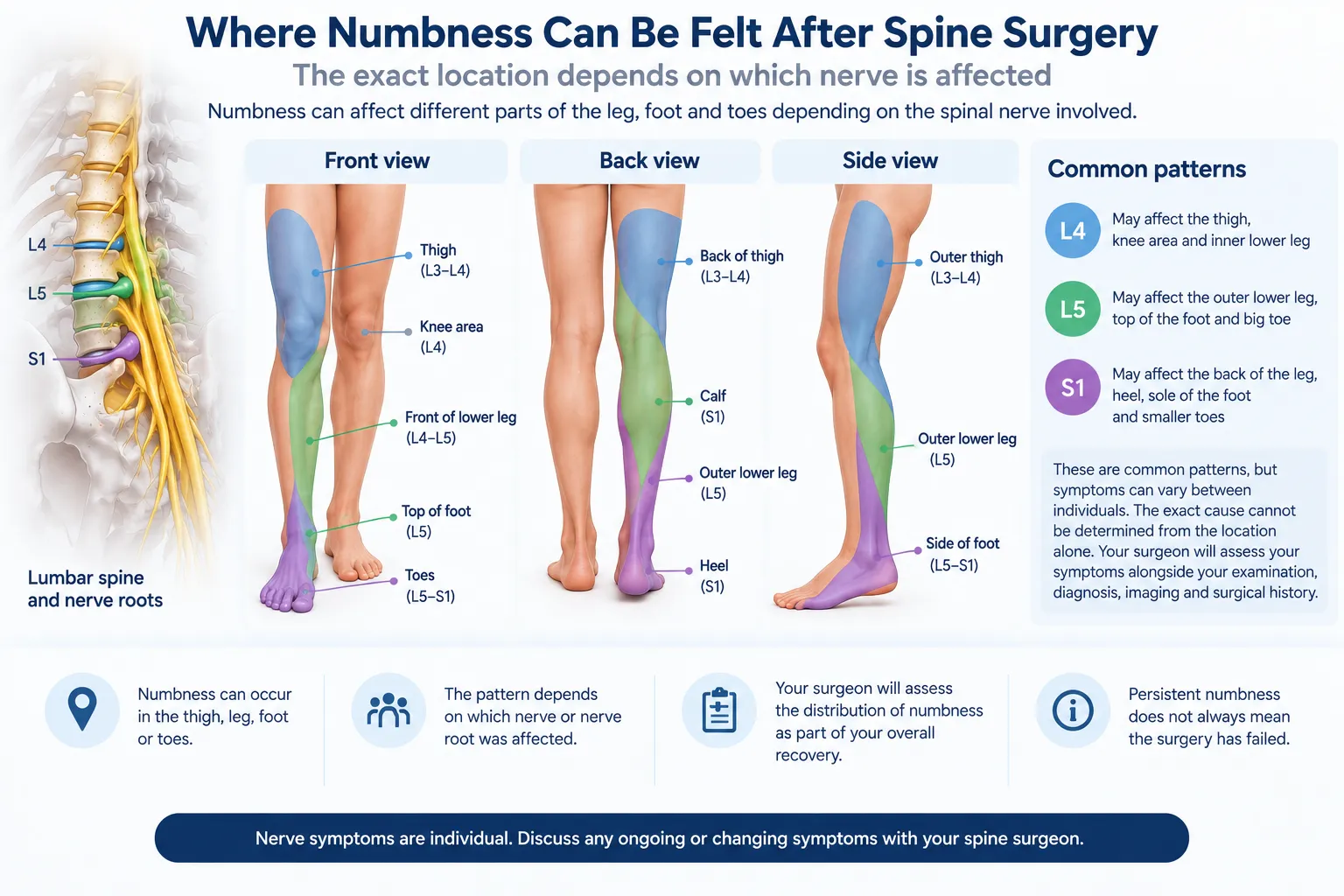
Persistent numbness can occur in different parts of the lower limb depending on which nerve or nerve root was affected.
Numbness in the Leg
Some patients experience altered sensation in part of the thigh, calf, or lower leg after surgery for a compressed lumbar nerve.
The exact distribution can vary according to the nerve involved.
Numbness in the Foot
Numbness may be felt in the foot, heel, sole, or top of the foot. The location can provide useful clinical information, although the exact cause cannot be determined from location alone.
Numbness in the Toes
Some patients notice that altered sensation is particularly noticeable in one or more toes.
Your surgeon or clinician will consider the distribution of numbness alongside your examination, diagnosis, imaging, and surgical history.
What Is the Difference Between Numbness and Weakness?
Numbness and weakness are both neurological symptoms, but they describe different problems.
Numbness refers to altered or reduced sensation. You may have difficulty feeling touch, temperature, or other sensations in part of the leg or foot.
Weakness refers to reduced muscle strength or difficulty moving a part of the body normally. For example, you may find it harder to lift the front of the foot, stand on your toes, or move the leg as you normally could.
This distinction is important because new or worsening weakness after spine surgery can indicate a change in nerve function that requires prompt medical assessment.
If you have persistent numbness but your strength and other symptoms are stable or improving, this may represent a different recovery pattern. Nevertheless, ongoing neurological symptoms should be discussed during your postoperative follow-up.
If weakness develops suddenly, becomes progressively worse, or is associated with rapidly increasing numbness or other significant symptoms, seek medical advice promptly.
Is Tingling After Spine Surgery a Sign of Nerve Recovery?
Tingling and pins-and-needles sensations can occur during recovery from nerve compression.
Some patients describe sensations such as:
- Tingling
- Pins and needles
- Mild burning
- Increased sensitivity
- Reduced sensation
- An unusual feeling when touching the skin
These sensations can change as the nerve recovers.
However, tingling should not automatically be interpreted as proof that a nerve is healing. What matters is the overall clinical picture and whether symptoms are improving, stable, or worsening.
If new tingling is accompanied by increasing weakness, rapidly worsening numbness, or other significant neurological symptoms, it should be assessed promptly.
Why Can Numbness Change During Recovery?
Postoperative nerve symptoms do not always remain exactly the same from day to day.
During recovery, you may notice that numbness becomes more noticeable at certain times or that the sensation changes from numbness to tingling, sensitivity, or another unusual feeling.
Activity and position can also influence how symptoms are perceived. For example, you may become more aware of an altered sensation after spending a long time sitting, walking for longer than usual, or increasing your activity during recovery.
A temporary change does not necessarily mean that the nerve has become newly damaged. However, the direction of change is important.
If symptoms settle again and your overall recovery is progressing, your medical team may simply continue to monitor them. If numbness becomes progressively more extensive, pain returns significantly, or weakness develops, you should contact your surgeon for assessment.
Keeping track of significant changes in your symptoms can also help your surgeon understand how your recovery is progressing.
What Affects Nerve Recovery After Spine Surgery?
Recovery depends on several factors.
How Long the Nerve Was Compressed
A nerve that has been compressed for a prolonged period may take longer to recover than one affected for a shorter period.
The Severity of Nerve Compression
More significant compression can result in more pronounced neurological symptoms and potentially a longer recovery.
The Degree of Nerve Damage
Compression can affect nerve function to different degrees. The extent of pre-operative nerve involvement can influence how much sensation eventually returns.
The Underlying Spinal Condition
Numbness can occur with conditions such as a herniated disc, spinal stenosis, and other causes of nerve compression. The underlying diagnosis affects both treatment and recovery.
The Type of Surgery
Different procedures are used to treat different spinal problems. These can include discectomy, decompression, laminectomy, fusion, and minimally invasive or endoscopic procedures.
The surgical technique is only one part of the picture. The condition being treated and the state of the affected nerve are also important.
Individual Recovery
Every patient heals differently. Age, general health, pre-existing neurological problems, rehabilitation, and other individual factors may also influence recovery.
Can Numbness Become Permanent After Spine Surgery?
In some patients, sensory changes can persist long term.
This can be a greater concern when the nerve was severely or chronically affected before surgery. Relieving pressure on the nerve can address the underlying compression, but a nerve that has already sustained significant damage may not always return completely to its previous function.
However, persistent numbness soon after surgery should not automatically be considered permanent.
Nerve recovery can take time, and the eventual outcome cannot usually be determined simply from how numb an area feels during the early postoperative period.
Your surgeon can provide a more individualised assessment based on the original condition, neurological examination, surgical findings, and progress during follow-up.
When Should You Be Concerned About Numbness After Spine Surgery?
Although some postoperative numbness can be part of recovery, certain symptoms require prompt medical attention.
Contact your surgical team or seek urgent medical assessment if you develop:
- New or worsening weakness in the leg or foot
- Rapidly increasing or spreading numbness
- New difficulty walking
- New loss of bladder or bowel control
- Numbness around the inner thighs, buttocks, or genital area
- Severe or rapidly worsening neurological symptoms
- Significant new symptoms following surgery
These symptoms should not simply be attributed to normal recovery without medical assessment.
If you are unsure whether a change in your symptoms is expected, contacting your surgical team is the safest approach.
What Can You Do While Your Nerves Recover?
There is no way to guarantee how quickly a nerve will recover, but following your postoperative plan can support a safe recovery.
Follow Your Surgeon’s Instructions
Your activity restrictions and rehabilitation plan will depend on the procedure you have undergone and your individual circumstances.
Gradually Increase Activity
Walking and other activities may be encouraged after many spine procedures, but activity should be increased according to your surgeon’s advice rather than based on a fixed timetable.
Attend Recommended Follow-Up Appointments
Follow-up allows your surgeon to assess pain, sensation, strength, mobility, and other aspects of recovery.
Pay Attention to Changes in Symptoms
It can be helpful to notice whether numbness is becoming less extensive, whether sensation is returning, or whether new symptoms are developing.
Avoid Trying to Force Recovery
More activity is not necessarily better. Excessive activity that significantly increases pain or neurological symptoms should be discussed with your medical team.
When Should You Contact Your Spine Surgeon?
If numbness persists but is gradually improving, it can often be monitored as part of the recovery process.
You should nevertheless discuss ongoing symptoms during your scheduled follow-up appointments, particularly if the numbness is interfering with walking, balance, or everyday activities.
Contact your surgeon sooner if:
- Numbness is getting worse rather than better
- A new area becomes numb
- Weakness develops
- Pain returns or becomes significantly worse
- You develop new neurological symptoms
Your surgeon can determine whether the symptoms are consistent with expected recovery or whether further examination or investigation is necessary.
Frequently Asked Questions
Can numbness last after spine surgery?
Yes. Numbness can persist after spine surgery because an affected nerve may take longer to recover than it takes for pain to improve. The duration varies depending on the underlying condition and the extent of nerve involvement.
How long does numbness last after spine surgery?
There is no universal timeframe. Some patients improve within weeks, while others may experience altered sensation for several months or longer. Recovery depends on factors including the duration and severity of nerve compression.
Why is my pain gone but my leg is still numb?
Pain can improve before normal sensation returns. Although surgery may relieve pressure on the affected nerve, the nerve may need additional time to recover its function.
Is tingling after spine surgery normal?
Tingling and pins-and-needles sensations can occur during recovery from nerve compression. However, new or worsening neurological symptoms should be discussed with your medical team.
Can numbness in the foot improve after back surgery?
Yes. Foot numbness can improve after surgery when it was caused by a compressed or irritated spinal nerve. The extent and speed of recovery depend on the condition of the nerve before surgery.
Does numbness mean spine surgery has failed?
Not necessarily. Persistent numbness does not by itself indicate surgical failure. A nerve may continue recovering after the source of compression has been treated.
Can nerve damage cause permanent numbness after spine surgery?
In some cases, significant or long-standing nerve damage can result in persistent sensory changes. However, numbness during the early stages of recovery does not necessarily mean that it will be permanent.
When should I worry about numbness after spine surgery?
New or worsening weakness, rapidly increasing numbness, loss of bladder or bowel control, saddle-area numbness, or other significant neurological changes require prompt medical assessment.
Can nerves recover after spinal surgery?
Nerves can recover after the source of compression has been relieved, but recovery varies considerably between patients. The extent of pre-operative nerve involvement and the duration of compression are among the factors that can influence the outcome.
