 Mr Bhaskar Thakur
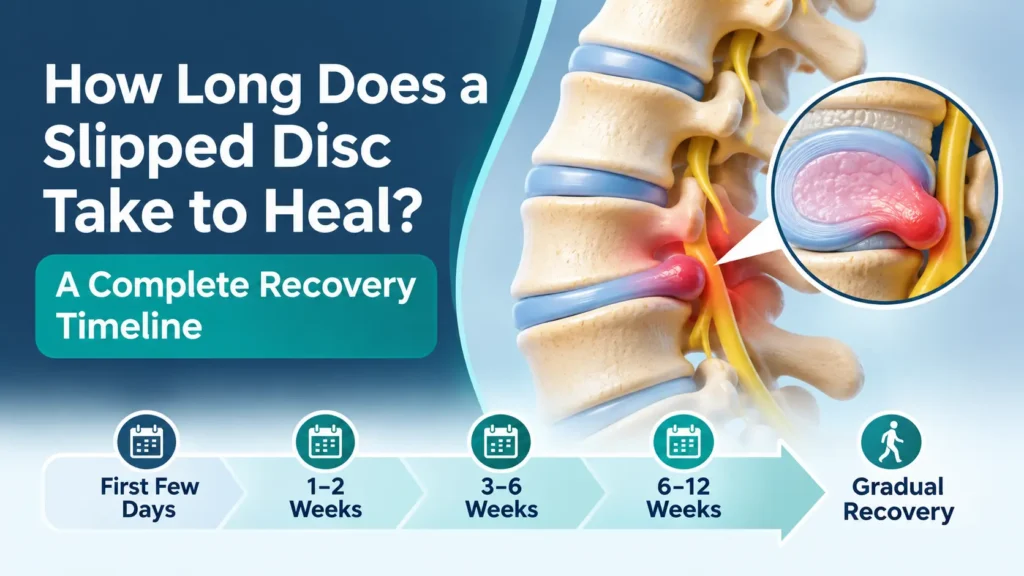
If you have recently been diagnosed with a slipped disc, one of the first questions you may have is: how long does a slipped disc take to heal?
The answer is different for everyone. Many people improve gradually over several weeks, while others may continue to have symptoms for several months. Recovery can depend on the location and severity of the disc problem, whether a nerve is irritated or compressed, and how your symptoms change over time.
Table of Contents
- How long does a slipped disc take to heal?
- What is a slipped disc?
- Slipped disc, herniated disc and disc prolapse: are they the same?
- Slipped disc recovery timeline
- What happens during the first few days?
- What happens during the first 2 weeks?
- What happens after 4 weeks?
- What happens after 6 weeks?
- What happens after 8–12 weeks?
- How do you know a slipped disc is getting better?
- Why can numbness last after the pain improves?
- Can a slipped disc heal on its own?
- Does the disc itself return to normal?
- What can slow down recovery?
- Should you rest or stay active?
- When might you need an MRI?
- When does a slipped disc need surgery?
- When should you seek urgent medical help?
- Frequently asked questions
- Conclusion
How Long Does a Slipped Disc Take to Heal?
A slipped disc can improve over several weeks, but there is no single recovery time that applies to everyone.
Some people notice a clear improvement within the first few weeks. Others continue to have symptoms for several months, particularly when a nerve is irritated or compressed.
It is also important to understand that feeling better and the disc looking completely normal on an MRI are not necessarily the same thing.
A person can have significant improvement in pain and movement even when an MRI still shows a disc bulge or herniation.
Many people with a slipped disc improve without surgery. The NHS guidance on slipped discs explains that symptoms often improve gradually and that surgery is not usually needed.
So, if you have recently been diagnosed with a slipped disc, the more useful question is not simply:
“When will my disc be completely healed?”
It is:
“Are my symptoms gradually improving, and are there any signs that the nerve is becoming more affected?”
What Is a Slipped Disc?
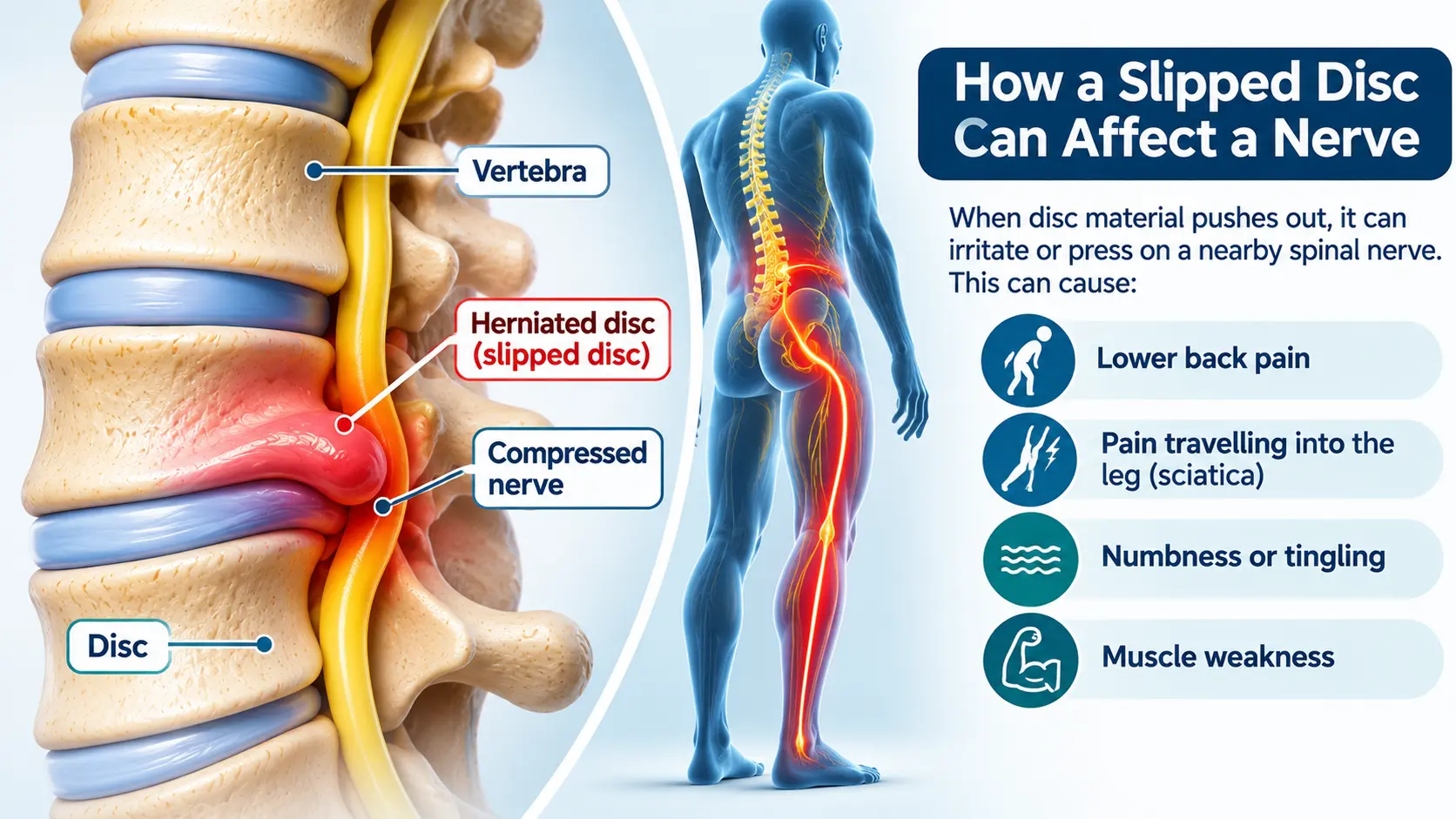
Your spine is made up of individual bones called vertebrae. Between these bones are soft discs that act as cushions and help your spine move.
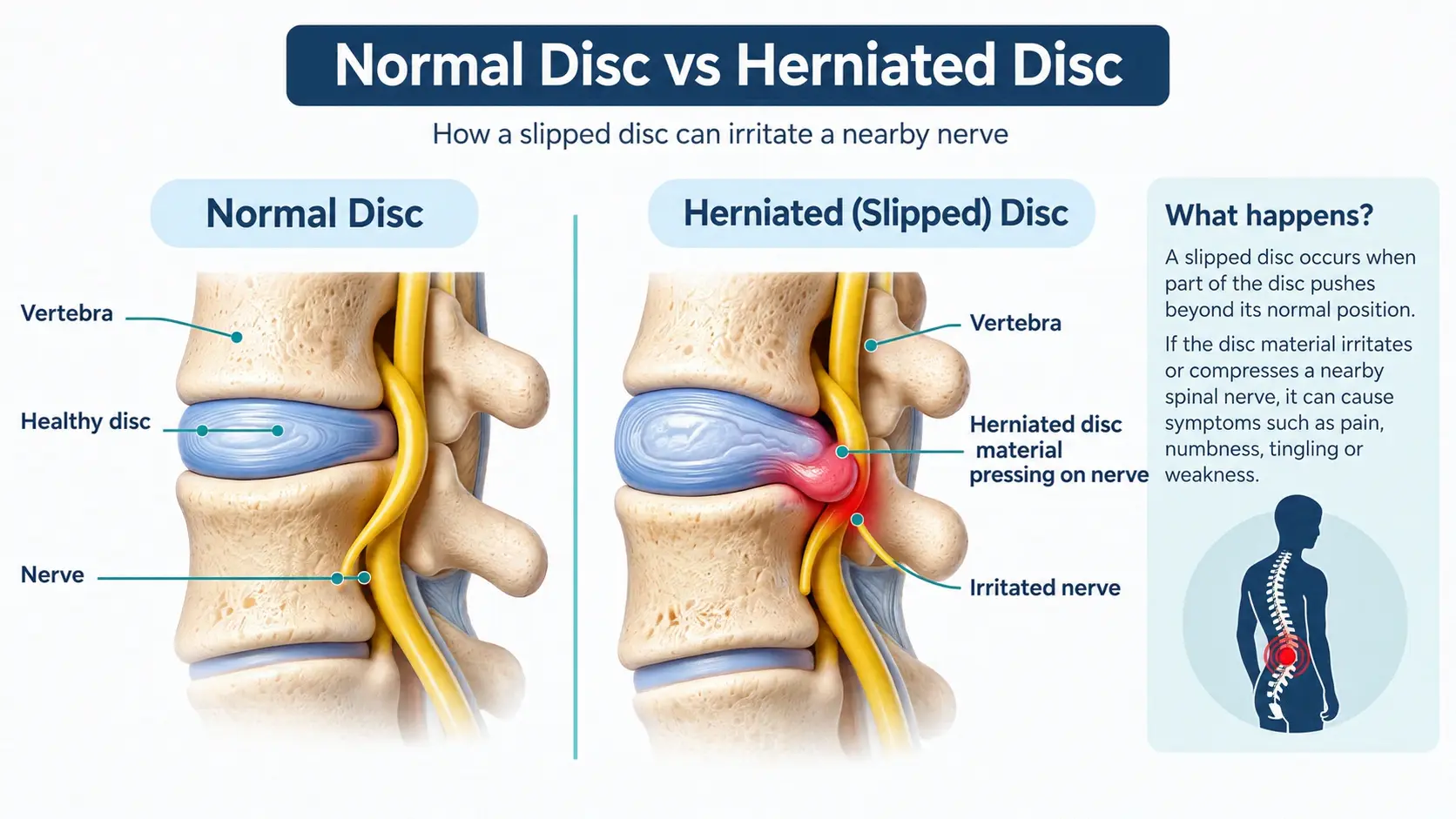
A disc has a strong outer layer and a softer centre.
Sometimes part of a disc pushes beyond its normal boundary. If the disc irritates or presses on a nearby nerve, it can cause symptoms such as:
- Lower back pain
- Neck pain
- Pain travelling into an arm or leg
- Numbness or tingling
- Muscle weakness
- Sciatica
- Difficulty with certain movements
Not every disc problem causes symptoms. Some people have disc changes on an MRI without experiencing any pain at all.
This is one reason why an MRI result needs to be considered alongside your symptoms and physical examination.
Slipped Disc, Herniated Disc and Disc Prolapse: Are They the Same?
You may hear several different terms used for a disc problem, including:
- Slipped disc
- Herniated disc
- Disc prolapse
- Disc herniation
- Disc extrusion
- Bulging disc
In everyday language, slipped disc, herniated disc and disc prolapse are often used to describe related disc problems.
The term “slipped disc” can actually be misleading because the disc does not literally slide out of place. Instead, disc material can bulge, protrude or herniate beyond its normal position.
A bulging disc, however, is not always the same as a true disc herniation. The exact appearance on an MRI can vary.
For recovery, what often matters most is:
- Where the disc problem is located
- Whether a nerve is being compressed
- How significant the compression is
- Your symptoms
- Whether you have weakness or numbness
- Whether your symptoms are improving
You can also read more about the condition on our Slipped Disc Treatment in London page.
Slipped Disc Recovery Timeline
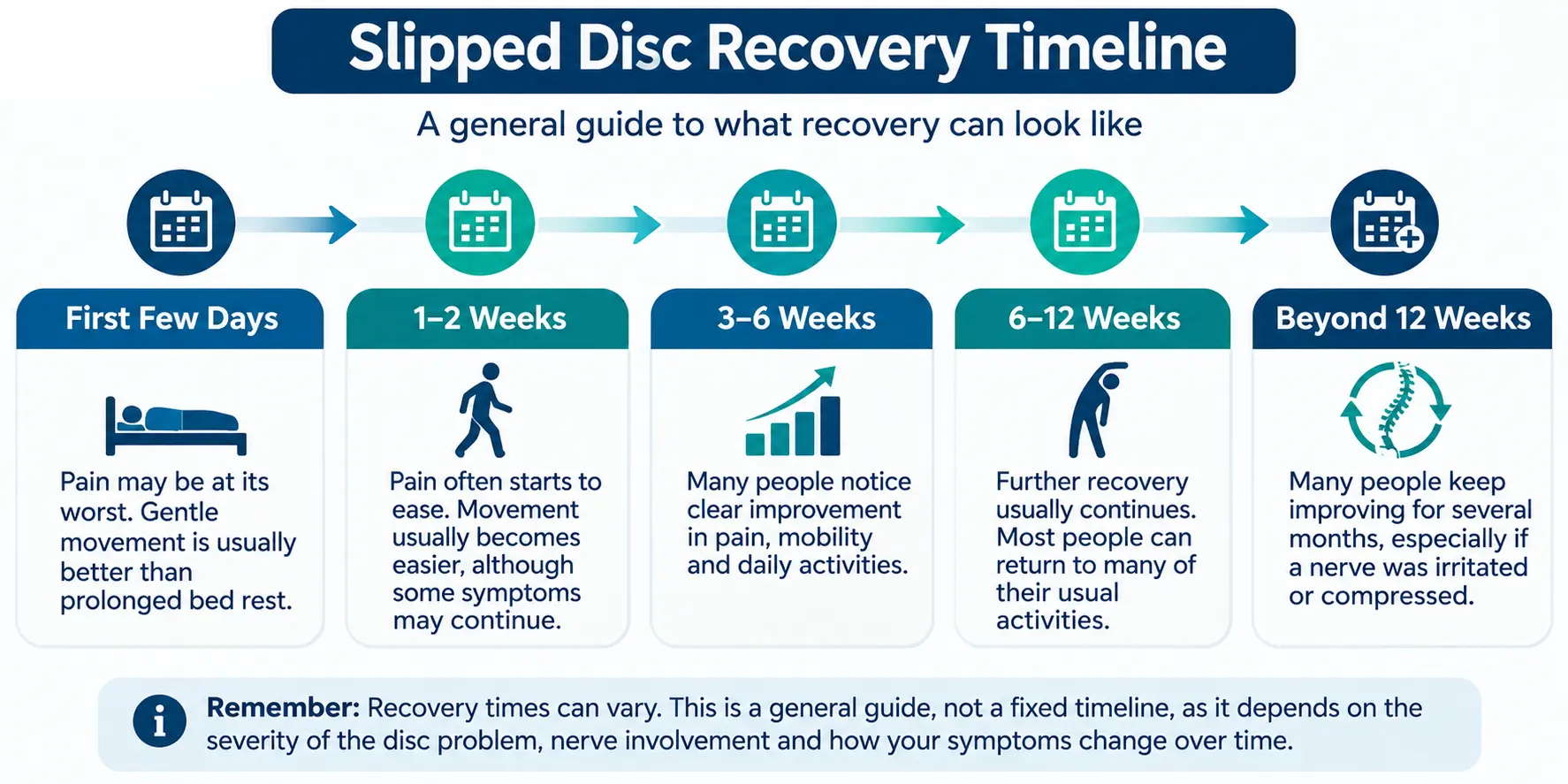
There is no guaranteed week-by-week schedule for recovery.
However, thinking about recovery in stages can help you understand what may happen.
| Stage | What may happen |
|---|---|
| First few days | Pain may be intense and movement may be difficult. |
| 1–2 weeks | Some people begin noticing easier movement and reduced pain. |
| 3–6 weeks | Symptoms may continue to settle, although nerve-related symptoms can remain. |
| 6–12 weeks | Many people continue to improve, while some may need further assessment if symptoms persist. |
| Beyond 12 weeks | Persistent or worsening symptoms may need a closer assessment of the diagnosis and treatment options. |
These are general stages, not fixed deadlines. Your recovery may be faster or slower.
What Happens During the First Few Days?
The first few days can be the most uncomfortable.
You may experience:
- Severe back or neck pain
- Leg or arm pain
- Muscle spasm
- Difficulty sitting or standing
- Difficulty bending
- Tingling or numbness
If a nerve is irritated, pain can travel away from the spine and into the leg or arm.
During this stage, complete bed rest is generally not the goal. Once you are able to move safely, gentle activity such as short walks may be more helpful than staying in bed for long periods.
The NHS recommends staying active and gradually returning to normal activity as symptoms allow.
What Happens During the First 2 Weeks?
By the first couple of weeks, some people begin to notice that the pain is becoming easier to manage.
You may notice:
- You can walk for longer
- You can change position more easily
- Pain is less intense
- Leg or arm pain occurs less often
- You are sleeping better
- Everyday activities are becoming easier
However, it is completely possible to still have symptoms at this stage.
Not being pain-free after two weeks does not automatically mean the disc is not healing.
Recovery is usually gradual rather than sudden.
What Happens After 4 Weeks?
Around four weeks, some people have made significant progress while others are still experiencing symptoms.
You may find that the original severe pain has reduced but that you still have:
- Occasional back pain
- Leg pain
- Tingling
- Numbness
- Stiffness
- Discomfort after sitting or standing for too long
One important point is that nerve symptoms can take longer to settle than pain.
For example, your leg pain might improve considerably while a patch of numbness remains.
That does not automatically mean permanent nerve damage.
What Happens After 6 Weeks?
Six weeks is often an important point when discussing persistent back and disc-related symptoms.
If you are steadily improving, that is generally encouraging.
But if you still have significant symptoms after several weeks, it may be appropriate to review your condition, particularly if:
- Pain remains severe
- Pain is stopping you from normal activities
- Symptoms are not improving
- Numbness is increasing
- You are developing weakness
- Your symptoms are getting worse rather than better
The NHS advises medical assessment when symptoms are not improving, and further investigation such as an MRI may be considered depending on the situation.
This does not mean everyone with symptoms at six weeks needs surgery.
It means your progress should be assessed in context.
What Happens After 8–12 Weeks?
Some people continue improving during this period.
Others may still have symptoms, particularly when a nerve has been significantly irritated.
If you are still experiencing substantial pain, numbness or weakness after several months, your doctor may need to reconsider:
- The original diagnosis
- The location of the disc problem
- Whether there is ongoing nerve compression
- Whether an MRI is appropriate
- Whether other treatments could help
- Whether surgery should be discussed
Research published in Clinical Spine Surgery found that spontaneous resorption of lumbar disc herniation occurs in a substantial proportion of patients treated conservatively, although the likelihood varies according to the type of herniation.
Read the PubMed meta-analysis on spontaneous resorption of lumbar disc herniation.
This means that a disc that is still visible on an MRI does not necessarily mean that treatment has failed.
How Do You Know a Slipped Disc Is Getting Better?
Recovery is usually better judged by your symptoms and function than by pain alone.
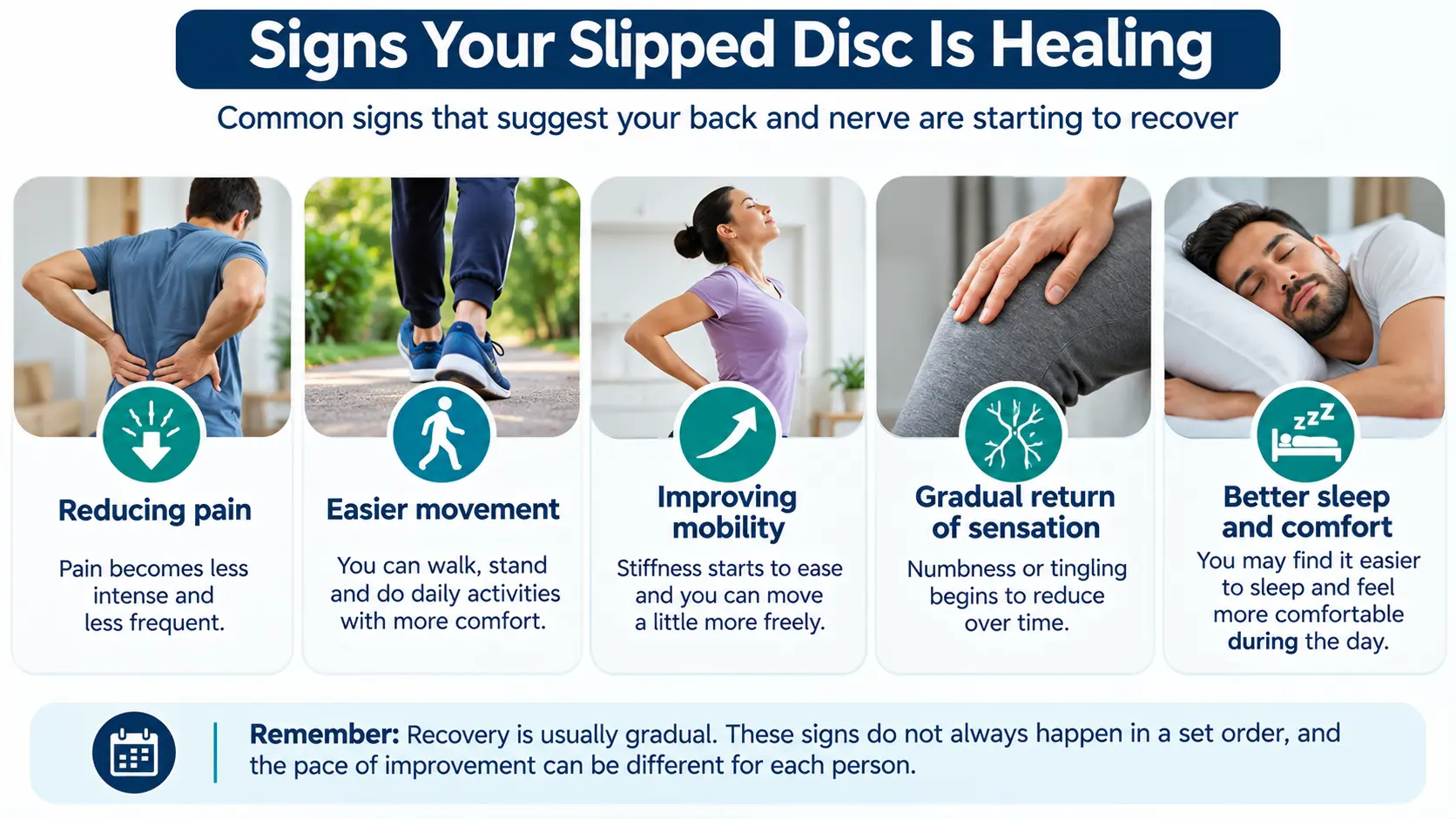
Less pain
The pain becomes less intense or occurs less frequently.
Better movement
You can walk, sit, stand or move more comfortably.
Less leg or arm pain
If a nerve is involved, pain travelling into your leg or arm may become less frequent or less intense.
Better sleep
You are able to sleep for longer without being woken by pain.
Improved strength
If you had mild weakness, your strength may gradually return.
Greater tolerance for normal activities
You can gradually do more without triggering the same level of symptoms.
Recovery does not always happen in a straight line.
You may have a good few days followed by a temporary flare-up.
A temporary increase in symptoms does not necessarily mean the disc has become worse.
Why Can Numbness Last After the Pain Improves?
This is an important question.
Pain, tingling, numbness and weakness are all possible effects of nerve irritation or compression, but they do not necessarily recover at exactly the same speed.
It is therefore possible for:
pain to improve first → followed by tingling → followed by gradual improvement in numbness or weakness.
The duration varies from person to person.
However, new or worsening weakness is different from stable mild symptoms and should be assessed promptly.
For example, difficulty lifting the front of the foot, sometimes called foot drop, can indicate significant nerve dysfunction.
Can a Slipped Disc Heal on Its Own?
Yes, many people improve without surgery.
This is one of the most important things to understand about a slipped or herniated disc.
“Getting better on its own” does not necessarily mean that the disc instantly returns to its original shape.
Symptoms can improve because:
- Inflammation around the nerve settles
- The irritated nerve becomes less sensitive
- The body gradually resorbs some herniated disc material
- Movement and function improve
- The surrounding tissues become less irritated
A systematic review published in 2024 found evidence that spontaneous resorption of lumbar disc herniation is common during conservative treatment, although the reported rate varies considerably between studies and according to the type of herniation.
Read the PubMed systematic review on spontaneous resorption of lumbar disc herniation.
These findings should not be interpreted as a guarantee that every patient will recover without treatment or surgery.
Does the Disc Itself Return to Normal?
Not always.
A person can feel much better even when an MRI still shows a disc bulge or herniation.
Conversely, an MRI may show a disc abnormality without that abnormality being responsible for someone’s symptoms.
This is why doctors do not usually treat an MRI scan in isolation.
The scan needs to be considered alongside:
- Your symptoms
- Physical examination
- Nerve function
- Duration of symptoms
- Changes over time
Research has shown that some herniated discs can gradually shrink or undergo spontaneous resorption, particularly certain types of herniation.
Read the PubMed review on the mechanisms of spontaneous disc resorption.
What Can Slow Down Recovery?
Recovery can vary for many reasons.
These may include:
- Significant nerve compression
- More extensive disc herniation
- Persistent inflammation
- Severe or long-lasting symptoms
- Poor sleep
- Reduced physical activity
- Difficulty returning to normal movement
- Other spinal conditions
- Repeated activities that aggravate symptoms
This does not mean that recovery is impossible if you have one of these factors.
It simply means that your recovery may not follow the same timeline as someone with a smaller or less symptomatic disc problem.
Should You Rest or Stay Active?
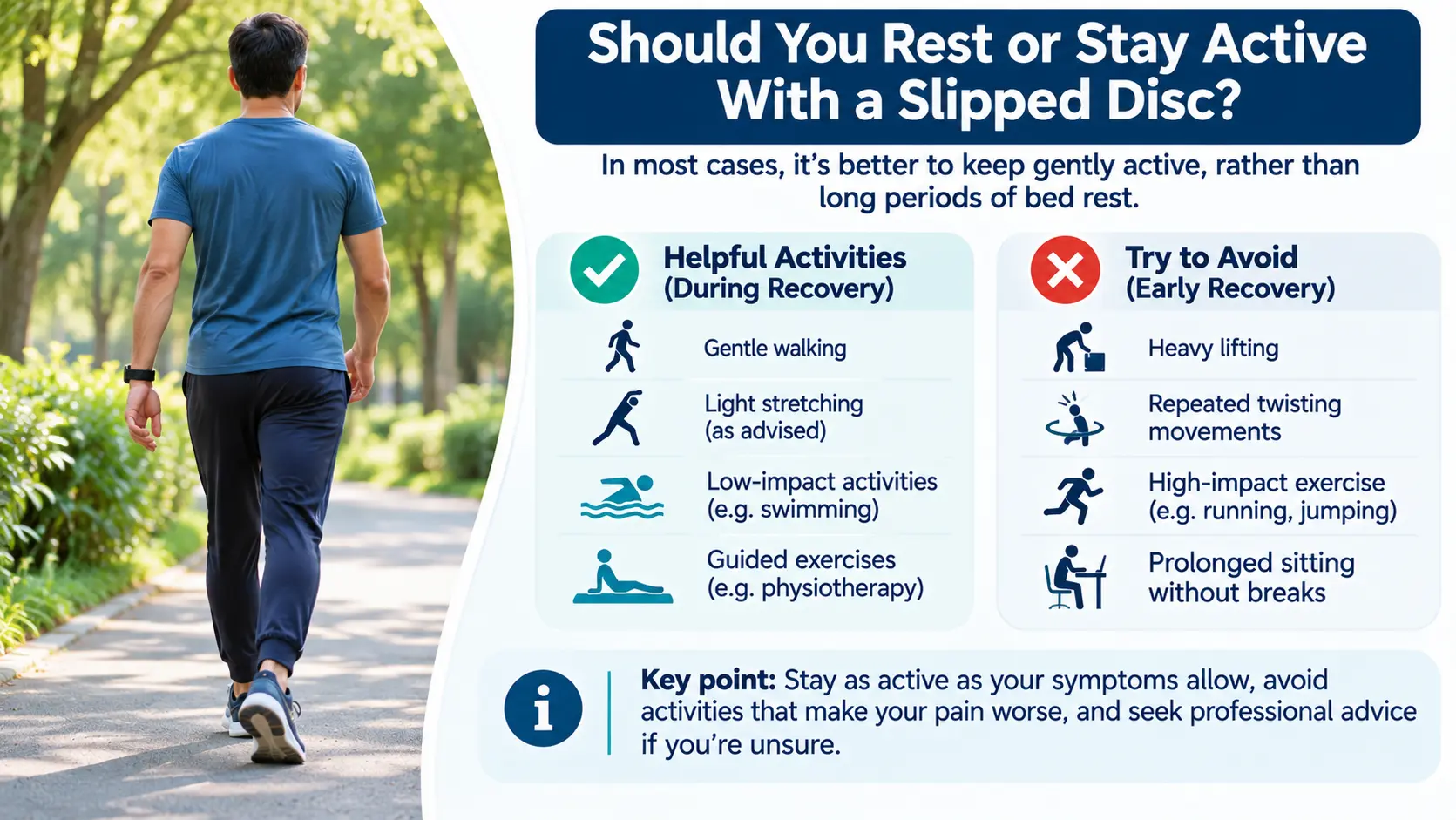
A common reaction to severe back pain is to stay in bed.
Short periods of rest may sometimes be necessary when pain is severe, but prolonged bed rest is generally not recommended.
As symptoms allow, gradually returning to normal movement can help you maintain strength and function.
Walking is often a simple way to start.
The important principle is:
If a particular exercise consistently makes your symptoms significantly worse, stop and seek professional advice.
The NHS recommends staying active and gradually returning to normal activity rather than remaining inactive for prolonged periods.
When Might You Need an MRI?
Not everyone with a slipped disc needs an MRI immediately.
A doctor may initially assess your symptoms and perform a physical examination.
An MRI may become more useful when:
- Symptoms are persistent
- Symptoms are getting worse
- There is significant or progressive weakness
- The diagnosis is uncertain
- Surgery or another intervention is being considered
- There are concerning neurological symptoms
An MRI can show where a disc is pressing or irritating a nerve, but the scan still needs to be interpreted alongside your symptoms.
Many people have disc abnormalities on imaging without having symptoms from them, which is why clinical assessment remains important.
When Does a Slipped Disc Need Surgery?
Most people with a slipped disc do not automatically need surgery.
Surgery may be considered when symptoms remain severe despite appropriate non-surgical treatment, or when there is significant or worsening neurological dysfunction.
The NHS explains that surgery is not usually needed, but specialist assessment may be appropriate when symptoms have not improved with other treatment or when there is worsening muscle weakness or numbness.
The decision depends on the individual patient.
It is not simply:
“MRI shows a herniated disc = surgery.”
Instead, doctors consider the combination of:
symptoms + examination + imaging + response to treatment.
If you are experiencing persistent symptoms from a slipped disc, you can learn more about slipped disc treatment in London with Mr Bhaskar Thakur.
When should you seek urgent medical help?
Seek emergency medical attention if back pain or a suspected slipped disc is accompanied by:
- Numbness around the genitals or anus
- Difficulty or inability to pass urine
- Loss of bladder or bowel control
- Significant loss of feeling in one or both legs
- Rapidly worsening weakness
These symptoms can indicate serious compression of the nerves at the bottom of the spine and require urgent assessment.
Frequently Asked Questions
How long does a slipped disc take to heal?
Many people improve over several weeks, but recovery can take longer. There is no fixed healing time because the severity of the disc problem, nerve involvement and individual response to treatment all vary.
Can a slipped disc heal without surgery?
Yes. Many people improve with non-surgical treatment. In some cases, the body can gradually resorb part of the herniated disc material. However, persistent severe symptoms or neurological problems may require specialist assessment.
How long does slipped disc pain last?
Pain often improves gradually over the first several weeks, but some people continue to have symptoms for longer. Persistent or worsening pain should be assessed rather than simply waiting indefinitely.
How do I know if my slipped disc is getting better?
Less pain, improved movement, better sleep, reduced leg or arm symptoms and greater ability to perform normal activities can all be encouraging signs. Recovery can fluctuate, so one bad day does not necessarily mean you are getting worse.
Can numbness from a slipped disc go away?
It can. Numbness may take longer to improve than pain because it can be related to nerve irritation or compression. Persistent or worsening numbness should be assessed, particularly if it is accompanied by weakness.
Does a slipped disc always need surgery?
No. Most people do not require surgery. Surgery may be considered when symptoms remain significantly disabling despite appropriate treatment or when there is significant or worsening neurological dysfunction.
Can a herniated disc shrink?
Yes. Some herniated discs can gradually shrink or undergo spontaneous resorption. The likelihood varies depending on the type and characteristics of the herniation.
What if my slipped disc has not improved after several weeks?
If symptoms are not improving, or if they are worsening, it is sensible to have your condition reassessed. Your doctor may consider further examination, imaging or a change in treatment depending on your symptoms.
What Should You Expect During Slipped Disc Recovery?
The most important thing to remember is that recovery is a process, not a deadline.
You may improve significantly in the first few weeks, while nerve-related symptoms such as numbness or weakness can take longer.
Some people recover without surgery. Some have symptoms that persist and require additional treatment. A smaller group may eventually need surgery, particularly when symptoms remain disabling or neurological function is deteriorating.
Your MRI is also only part of the picture. A disc abnormality can remain visible even when symptoms have improved, and some herniated discs can gradually shrink over time.
So rather than asking only:
“Has my disc healed yet?”
It is more useful to ask:
“Are my symptoms improving, is my function returning, and are there any signs of ongoing or worsening nerve problems?”
If you have persistent back or leg pain, numbness, weakness or other symptoms that are not improving, a spine specialist can assess the cause and discuss the most appropriate treatment options.
Are you experiencing persistent symptoms from a slipped or herniated disc?
If your pain, numbness or weakness is continuing despite treatment, specialist assessment can help determine whether the nerve is still being compressed and what treatment options may be appropriate.
Related Reading
- Signs Your Herniated Disc Is Healing: What to Look For
- How Long Does Slipped Disc Pain Last? What to Expect During Recovery
- Can a Slipped Disc Heal on Its Own? What the Evidence Says
- How Long Does Numbness Last After a Herniated Disc?
- When Does a Slipped Disc Need Surgery? Signs, Options and Recovery
About Mr Bhaskar Thakur
Mr Bhaskar Thakur is a Consultant Neurosurgeon and Spine Surgeon specialising in spinal conditions, minimally invasive spine surgery, lumbar disc disease, sciatica and nerve compression.
He provides specialist assessment for patients with persistent back pain, sciatica and slipped or herniated discs in London and Essex.
If your slipped disc symptoms are persistent, worsening or affecting your mobility and quality of life, specialist assessment can help determine the cause of your symptoms and the most appropriate treatment.
